Restricted by conventional technologies, metallurgical process control systems have long relied on mechanistic models built with simple algorithms. These models struggle to adapt to the complex characteristics of metallurgical processes, including strong nonlinearity, heavy coupling, large time lag and time-varying fluctuations. Common problems such as excessive overshoot, delayed regulation, gradual deterioration of control accuracy during operation, and failure to adapt to iterative process upgrades frequently occur. In severe cases, model runaway may happen, directly undermining production stability and product quality consistency. These intertwined pain points hinder the high-quality, high-efficiency and low-cost development of metallurgical production, calling for systematic optimization and breakthroughs via core technological upgrades.
01 Overall Approach to “AI + Precision Control”
Focusing on the whole rolling process, we build a new-generation precision control technical architecture featuring in-depth integration of AI large models and mechanistic models, and develop an AI agent matrix covering core processes including hot rolling, cold rolling, continuous annealing and continuous galvanizing. This realizes intelligent, collaborative and high-precision control across all working procedures, and forms a closed-loop AI precision control framework to address five key challenges in process control:
•High-precision prediction: Leveraging algorithms and big data to deliver accurate predictions for multiple scenarios and boost control efficiency and reliability.
•AI-enabled model reconstruction: Based on traditional mechanistic models, combined with reinforcement learning, path planning and dynamic optimization technologies, this solution tackles strong nonlinearity, time-varying parameters and multi-variable coupling of controlled objects, and improves model accuracy and applicability.
•Multi-dimensional decoupling: Decouple the coupled characteristics of controlled objects in terms of features, tasks and modes to achieve accurate decomposition and controllable generation. It enhances model generalization capacity to support efficient adaptation and stable iteration in complex scenarios.
•Interference pre-control: Identify, detect and classify erroneous information and data interference in real time via AI algorithms. The pre-control mechanism ensures credible data, system security and reliable decision-making.
•Human behavior learning: Analyze and learn human operation patterns from massive datasets, and optimize algorithms iteratively to improve the decision-making capability of control systems for more intelligent operation.
02Typical Application Scenarios of AI Precision Control
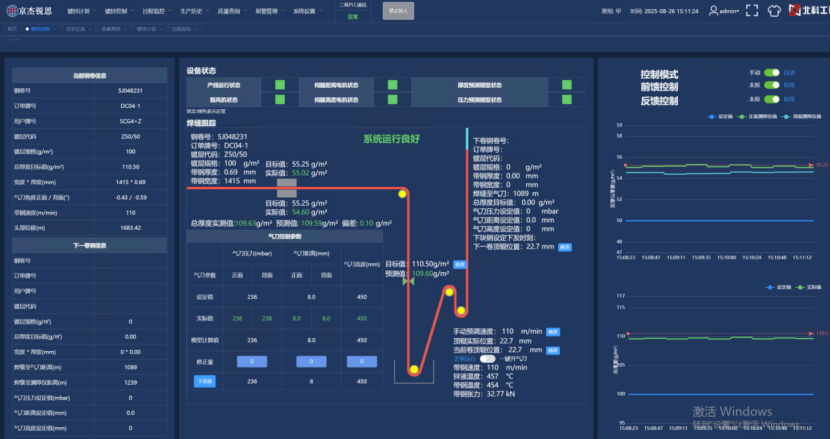
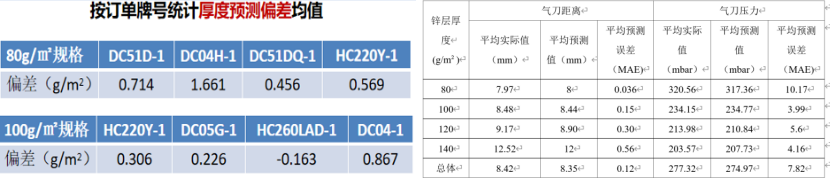
Precision Prediction: AI Control for Zinc Coating Thickness in Galvanizing — From Empirical Compensation to High-Precision Predictive Control
Pain points: The online detection of zinc coating thickness lags behind production. Traditional control depends on operator experience and fails to eliminate the impacts of strip speed, zinc temperature and air knife parameters, resulting in large thickness deviation and poor uniformity of zinc coating.
AI Empowerment: Integrate data of air knife parameters, zinc temperature, strip speed and other indicators. Adopt the Gaussian Process Regression (GPR) model to dig into nonlinear correlations, realize accurate prediction of zinc coating thickness and reverse predictive adjustment of air knife parameters. This overcomes the lag of traditional control and achieves dynamic high-precision control of zinc coating thickness.
Results: Over 95% of zinc coating thickness values fall within the tolerance of ±1.5 g/m². Zinc consumption per ton of steel is reduced by 2–4 kg, cutting raw material waste significantly and lifting production efficiency and product competitiveness.
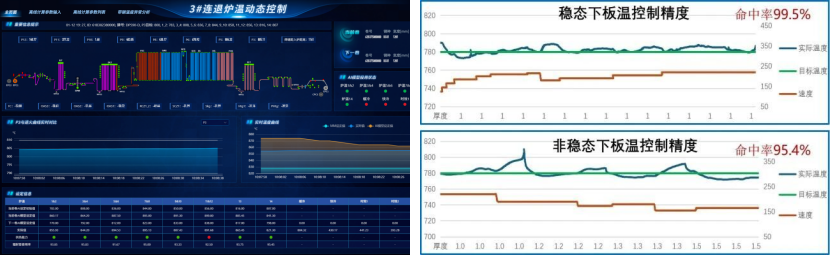
AI-enabled Model Reconstruction: AI Control Model for Annealing Furnace Temperature — From Simple Mechanistic Models to Complex Long-Delay Planning Models
Pain points: Continuous annealing furnaces for steel strips feature strong nonlinearity and intensive coupling among furnace temperature, strip temperature and internal medium. Traditional control models cannot cope with fluctuating working conditions and frequent changes of strip specifications, leading to dramatic strip temperature swings, unstable product performance, strip warping and strip deviation. These are the fundamental reasons why few conventional models for large-scale continuous annealing and galvanizing production lines operate normally in China.
AI Empowerment: Breaking the reliance on traditional mathematical models, we adopt a dynamic system function optimization model. Taking furnace zone temperature, strip properties, product quality and transition boundaries into comprehensive consideration, we dynamically optimize models according to production plans and establish a long-delay planning control model for strip temperature. It dynamically adjusts burner opening, heating power and cooling fan power to realize adaptive precise temperature control and stable production transition.
Results: Strip temperature control accuracy is greatly improved. The steady-state temperature hit rate reaches 99.5%, and the hit rate exceeds 90% during transition phases with manual intervention drastically reduced.
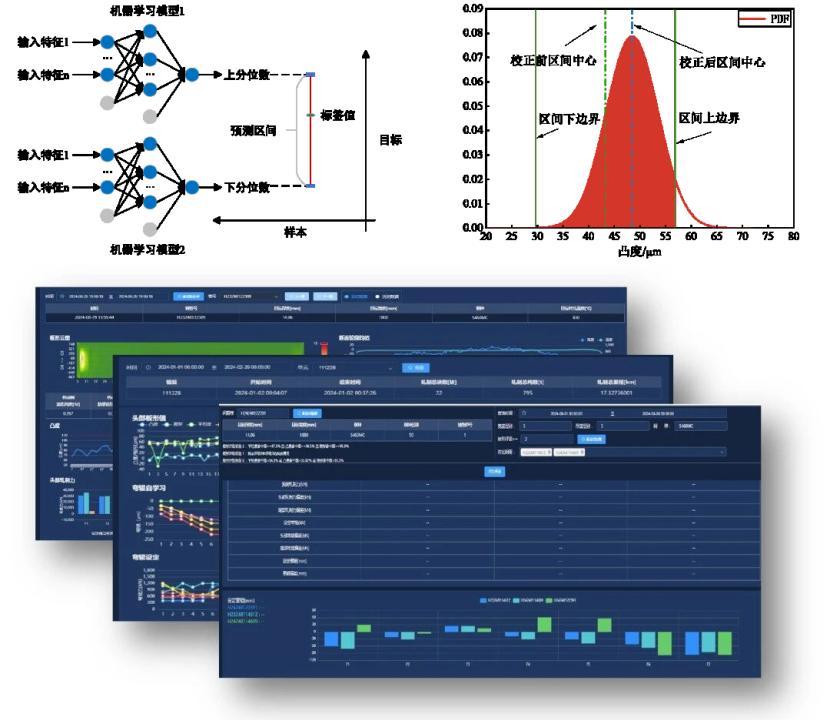
Multi-dimensional Decoupling: Multi-objective Precision Control of Strip Profile — Comprehensive Decoupling in Transverse and Longitudinal Directions
Pain points: Strip crown and flatness are strongly coupled. Profile defects and operational instability are inherited across hot rolling, cold rolling and continuous heat treatment processes. Conventional profile control largely relies on expert experience.
AI Empowerment: Build an intelligent multi-dimensional profile diagnosis and analysis system based on AI algorithms to conduct real-time analysis of full-length strip profile parameters and abnormal alarm, and accurately identify high-order cross-section defects and complex wave patterns throughout the production line. A radial basis function based similarity evaluation method is applied to analyze profile evolution over the full life cycle and conduct horizontal comparison across production cycles for the same product specifications. One-click differentiated parameter comparison helps trace the root causes of tricky profile defects and unstable production. By integrating profile control mechanistic models and AI algorithms, an intelligent closed loop of "parameter estimation - error modeling - robust compensation" is formed to realize adaptive multi-dimensional decoupling control.
Results: The mismatch between traditional mechanistic models and complex working conditions is resolved. The accuracy of crown prediction with deviation ≤10 μm is improved by over 12%, and manual intervention is cut by more than 65%. The system addresses limitations in profile analysis and difficulties in defect diagnosis: the recognition accuracy of high-order wave patterns exceeds 95%, the efficiency of full-process profile problem tracing rises by over 70%, and manual analysis workload is reduced by more than 80%.
Interference Pre-control: AI Control Model for Zinc Pot Temperature in Galvanizing — From Passive Regulation to Proactive Interference Pre-control
Pain points: Traditional zinc pot temperature control suffers from obvious lag. Temperature fluctuates sharply due to slag skimming and zinc feeding, causing frequent start-stop of high-power heaters, unstable zinc liquid flow field and inconsistent zinc slag, which impair strip surface quality.
AI Empowerment: Integrate heat and mass balance models of zinc pot and steel strips. Adopt nonlinear fitting and feature data identification and prediction technologies to capture changing trends of interferences. The system realizes real-time pre-control of strip inlet temperature and dynamic zinc feeding strategies, adopting a proactive interference-oriented pre-control mode to stabilize the process temperature of zinc liquid.
Results: Temperature fluctuation is controlled within ±1.5 ℃. The rate of appearance defects drops by 40%, and the number of high-power startups of electromagnetic induction heaters is reduced by over 80%.
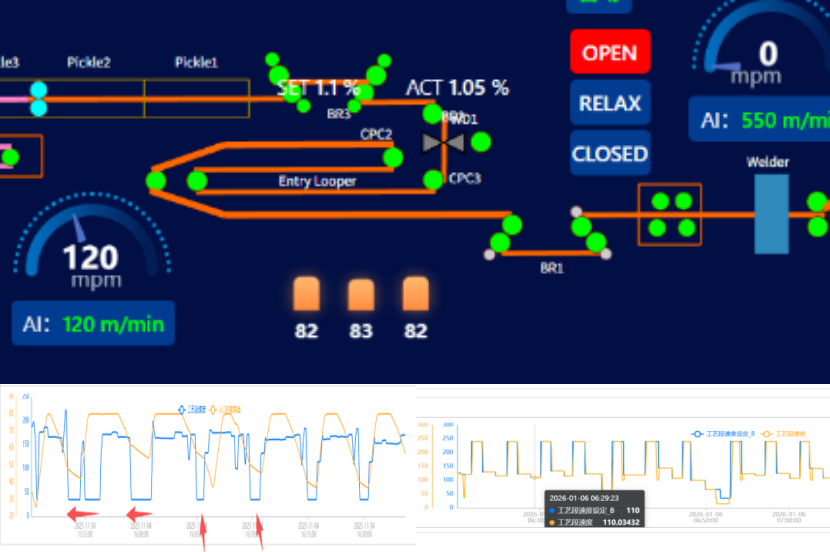
Human Behavior Learning: AI Control for Pickling & Rolling Production Rhythm — From Empirical Manual Operation to Intelligent AI Management
Pain points: The production rhythm of pickling and rolling lines is unstable. Manual control is easily affected by raw material fluctuations and equipment conditions, leading to excessive operational margins. Rigid fully automatic control logic also restricts output and production stability.
AI Empowerment: Based on LSTM and reinforcement learning algorithms, the system perceives operator behavior, unit operating status and hot rolling raw material characteristics, and builds a dynamic optimization control model for rolling rhythm. It predicts and adaptively adjusts the optimal production rhythm curve in real time, forming a complex closed loop of "perception - decision - execution" with self-iteration and optimization to achieve full-line intelligent rhythm control for pickling and rolling.
Results: Production rhythm stability is greatly enhanced. Frequent speed changes decrease by over 50%, unplanned downtime is cut by 20%, and steady output growth is guaranteed.
Targeting core pain points of traditional process control systems, we match solutions for the five major challenges with diverse application scenarios, and build a new technical architecture combining AI large models and mechanistic models. The developed AI process model matrix for the whole rolling process improves the accuracy, self-analysis and self-decision capability of control systems. Practices prove that these solutions effectively reduce production failures, and boost product quality and operational efficiency.
03 Implementation and Promotion of AI + Precision Control
The AI precision control model matrix developed by IET,USTB has been deployed on dozens of domestic iron and steel enterprises, and also promoted to Taiwan region of China and POSCO in South Korea. Cold rolling AI precision control models have been successfully applied in Angang, Benxi Iron & Steel, XichangPanzhihua Iron & Steel, Magang, Lianyuan Iron & Steel and other major steel enterprises, demonstrating great promotion value.
Featuring strong universality, the AI precision control models can be quickly adapted to different production lines. Empowered by AI technologies, they help domestic steel enterprises achieve quality improvement, efficiency growth and intelligent transformation. The core technologies can be extended to metal rolling and process industries, and will be continuously upgraded with digital twin and intelligent management & control technologies.


官方公众号


