With the upgrading of high-end manufacturing, higher requirements are set for the precision and consistency of steel products. Traditional manual visual inspection and single-sensor detection expose increasingly prominent drawbacks: they fail to keep pace with production line speed, suffer from high defect omission and misjudgment rates, and fall short in dimensional accuracy control and dynamic deviation correction. These problems have become major quality bottlenecks restricting steel enterprises from entering high-end markets and upgrading products.
01 Overall Approach: Shift from Post-Inspection to Real-Time Control & Pre-Prediction
Intelligent production inspection is the core support for high-end steel product development during the digital transformation of the industry. Deeply empowered by AI technologies, we break the limitations of traditional inspection. By fusing visual perception, multi-source sensor data and real-time analysis capabilities, we build a full-process high-precision inspection system to transform quality control from post-inspection to real-time management and predictive prevention. This is critical for improving product yield and breaking barriers to the high-end market.
Aiming at core pain points including difficult defect identification, insufficient dimensional precision, poor dynamic deviation control and low data reusability in steel plate production, the AI + intelligent inspection solution eliminates data silos across sensors, algorithms, production lines and management systems. An integrated system of real-time data collection - AI analysis - accurate judgment - closed-loop regulation is established to achieve quality improvement and efficiency growth: AI algorithms accurately identify defects and dimensional deviations to reduce labor dependence; multi-modal sensor fusion realizes millisecond-level detection adapted to high-speed production lines; inspection data is linked with process parameters to trace root causes and optimize production reversely; inspection samples and models are continuously updated to form an iterable quality knowledge system.
Based on this system, five key technologies are implemented to comprehensively upgrade steel inspection and resolve traditional bottlenecks.
02 Five Core Technologies for Breaking Traditional Bottlenecks
Deep Learning-based Visual Perception & Defect Recognition Technology
From rough manual inspection to precise AI analysis
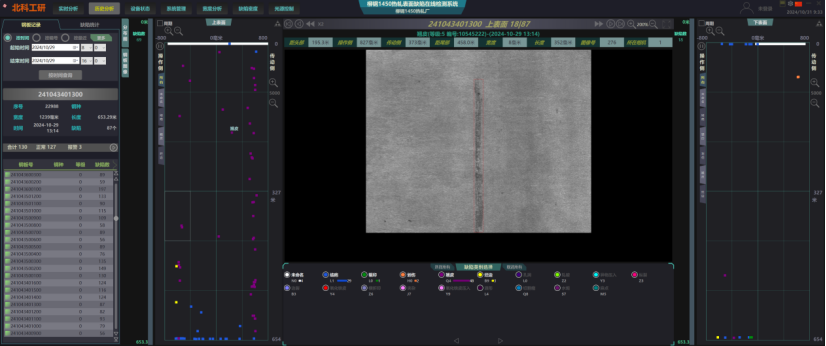
Traditional surface defect detection relies on manual work and simple threshold analysis. Affected by various defect types and complex on-site environments, it has high omission and misjudgment rates, and cannot classify defects quantitatively or adapt to high-speed production lines. We build a million-level full-category defect sample library via cross-domain defect generation technology, and optimize deep learning models with attention mechanism and multi-scale feature fusion to realize precise positioning, classification and grading of defects.
Results: Applicable to hot and cold rolling working conditions, the system can identify more than 60 types of common defects with a recognition accuracy of over 90% and an over-detection rate below 5%. It eliminates subjectivity and inefficiency of manual inspection, and has been deployed on over 250 production lines at home and abroad.
Machine Vision-based High-Precision Online Measurement Technology
From traditional contact measurement to non-contact high-speed precise detection
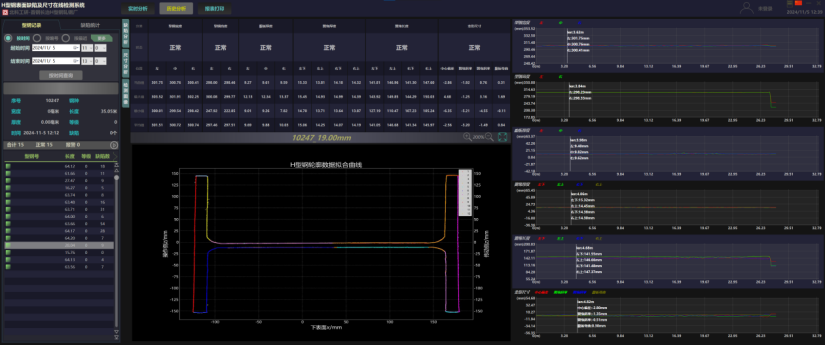
Dimensional accuracy is a core indicator for high-end steel products. Traditional contact measurement and single vision measurement feature low speed, easy wear, insufficient precision and isolated data. Combining structured light based on triangulation principle and high-resolution industrial cameras, the technology adopts AI algorithms for image correction and sub-pixel edge extraction, realizing high-precision online measurement for all types of steel products and capturing subtle dimensional changes in real time.
Results: The detection accuracy reaches ±1 mm for strip width, ±0.05 mm for strip thickness, and ±0.1 mm for key dimensions of long products. The detection efficiency is over 5 times higher than that of traditional methods.
Time Series Analysis-based Dynamic Operation Monitoring & Trend Early Warning Technology
From passive response to active early warning
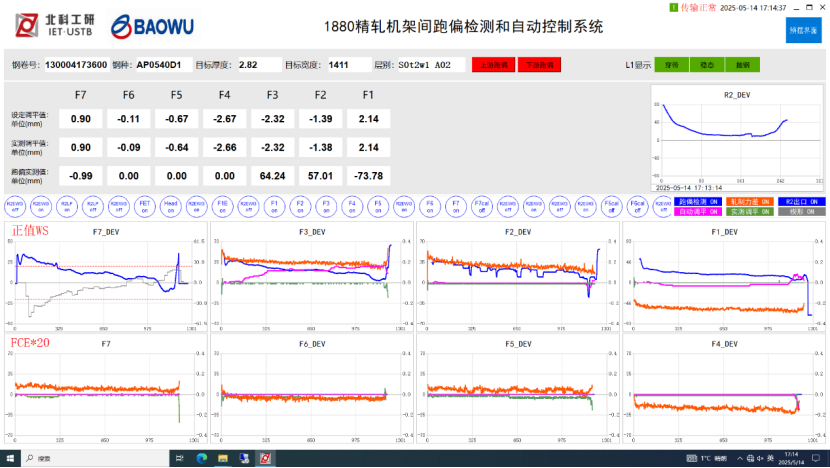
Strip deviation, camber and operational errors often cause production downtime and material loss, while traditional monitoring is passive and lagging. The system collects real-time time-series data via sensors, and builds dynamic analysis models based on RNN and LSTM to extract strip operation features. It realizes dynamic monitoring, early warning and precise regulation for strip deviation, camber and other working procedures.
Results: Data processing delay is less than 50 ms, and the accuracy of shape and process control exceeds 95%, greatly reducing material loss and downtime. This technology has been applied on multiple production lines of major steel enterprises including Shougang, Baowu, Angang and Lianyuan Iron & Steel, and was selected as a demonstration scenario for the digital transformation of China's steel industry during the 14th Five-Year Plan period.
Industrial Big Data-based Intelligent Judgment & Closed-Loop Optimization Technology
From scattered manual judgment to AI intelligent analysis
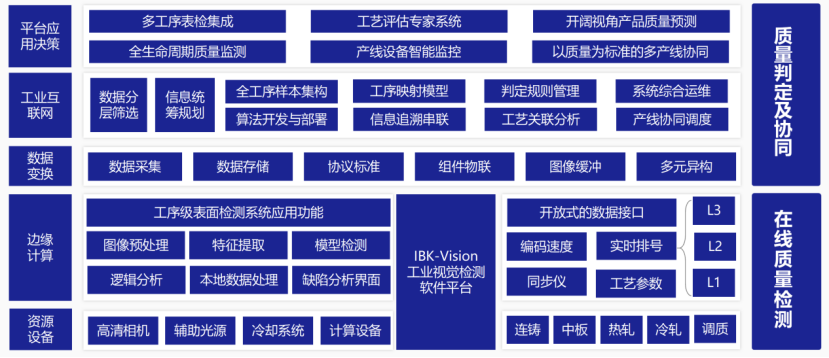
Traditional inspection data is fragmented with inconsistent manual judgment standards, and inspection work is disconnected from production processes, hindering quality improvement. We integrate multi-dimensional data via big data platforms and build AI quality judgment models to grade products accurately, locate process problems and generate optimization schemes fed back to production links. A closed loop of "detection - judgment - analysis - optimization - re-detection" is formed.
Results: Judgment efficiency increases by over 50%, and manual workload is reduced by 80%. Product defect rates are effectively lowered to meet the upgrading demands of high-end production lines.
Machine Vision-based Integrated Inspection Technology for Smart Factories
From single-point detection to full-scenario integrated management
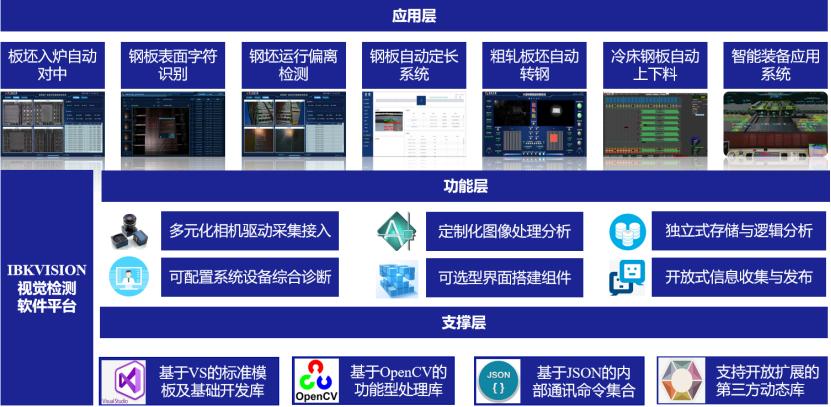
Centering on machine vision inspection, this technology is deeply deployed at key nodes across the whole steel production process. It breaks the limits of single-point detection and realizes integrated inspection for multiple scenarios, supporting collaborative management of smart factories and connecting inspection links with production line regulation.
Results: The system covers character recognition, crop end detection, loading and unloading inspection, liquid level detection, centering positioning and other scenarios. The basic detection accuracy for all items is over 99.5%, and reaches 100% in some optimized scenarios, boosting the construction efficiency of smart factories.
03 Implementation and Promotion of AI + Intelligent Inspection
The AI + intelligent inspection solution has been deployed in leading steel enterprises such as Baowu, Shougang and Lianyuan Iron & Steel. Over ten million inspection records and more than ten AI inspection tools have been accumulated, forming a multi-category inspection model library. Adaptable to the whole production process, the deep integration of AI and inspection technologies stabilizes product quality, and drives the steel industry to shift from scale expansion to high-quality development focusing on product quality and high-end positioning.


官方公众号


