Against the dual background of national policies promoting the intelligent, green, and integrated development of the manufacturing sector and intensifying industry competition, equipment operation and maintenance (O&M) in iron and steel enterprises faces three core pain points that urgently need to be addressed:First, insufficient capability for predictive maintenance of equipment under complex working conditions, leading to poor timeliness in detecting and diagnosing potential faults.Second, the lack of scientific quantitative evaluation methods for the service status of key equipment, making it difficult to monitor degradation trends and prone to production instability and product defects.Third, weak capabilities in data value mining and multi‑business collaborative analysis, creating barriers to the coordinated optimization of equipment O&M with production, quality, cost, and other operations.
In recent years, IET has carried out a series of technological innovations focused on "AI + Equipment O&M", building a robust digital "safeguard net" for equipment support and effectively improving the Overall Equipment Effectiveness (OEE) of enterprises.
01 Overall Approach of "AI + Equipment O&M"
Targeting the three core pain points in equipment O&M for the metallurgical industry, we deeply integrate artificial intelligence technologies with the full‑process business of equipment O&M to build an intelligent empowerment architecture of "Platform + Data + AI Models + Scenario Applications". We anchor on three core directionsWhich are Intelligent convergence of multimodal data,AI‑driven fault diagnosis and early warning, And Deep learning‑empowered multi‑business collaboration.Through the in‑depth application of deep learning, knowledge graphs, AI agents, and other technologies, we drive two major transformationsFrom "humans looking for anomalies" to AI proactively detecting anomaliesAnd From "managing failures" to AI proactively identifying hidden dangers.We have built a "one‑stop" intelligent agent service platform for equipment O&M, realizing the transformation from single‑point manual maintenance to systematic intelligent O&M, and comprehensively solving the core challenges of equipment O&M in iron and steel enterprises.
02 Typical AI Application Scenarios of "AI + Equipment O&M"
(1)Multimodal Data Convergence in Complex Scenarios — From Disordered Data to Structured Empowerment
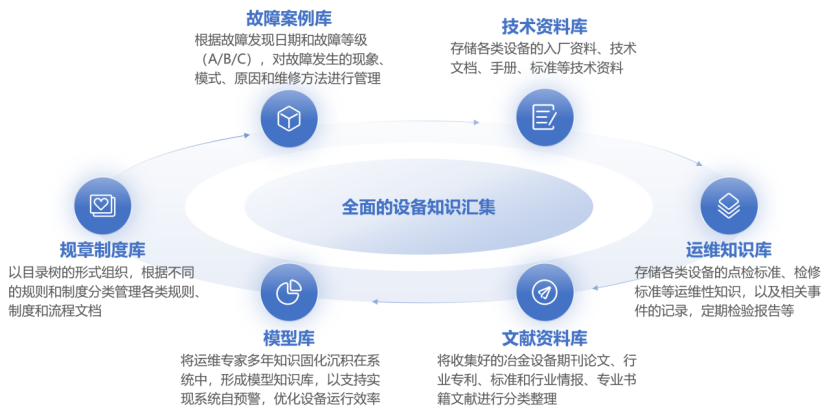
Equipment O&M in the iron and steel industry involves isolated data from multiple systems such as MES, SCADA, and inspection systems, as well as unstandardized multimodal data including sensors, documents, audio, and video. This results in high difficulty in data correlation analysis and low efficiency in value mining, failing to provide effective data support for subsequent intelligent O&M.To address this, we have built an AI‑driven multimodal data fusion system that intelligently parses, classifies, and indexes unstructured data such as journal papers, patent standards, fault reports, on‑site audio and video. We have established a three‑level proprietary knowledge base architecture adapted to the iron and steel industry: "Industrial Resource Layer – Knowledge & Experience Layer – Enterprise Application Layer", realizing hierarchical management and on‑demand invocation of data and knowledge.
Effect Comparison:Five major categories of data standardization AI models and 15 core data processing components have been developed, solving 20 types of cross‑system and cross‑type data correlation issues. Full‑dimensional equipment O&M data is now "visible, smoothly flowing, and connectable", while industry knowledge and on‑site experience are "manageable, searchable, and usable", laying a solid data and knowledge foundation for AI fault diagnosis and collaborative optimization.
(2)Multi‑Dimensional Fault Diagnosis Based on AI Agents — From Empirical Judgment to Precise Identification
Under high‑load and complex working conditions in iron and steel enterprises, equipment fault warnings are delayed and highly dependent on O&M personnel experience, leading to inaccurate positioning, high rates of missed and false judgments, and low fault handling efficiency. Early equipment degradation cannot be captured in advance, easily causing unplanned downtime.
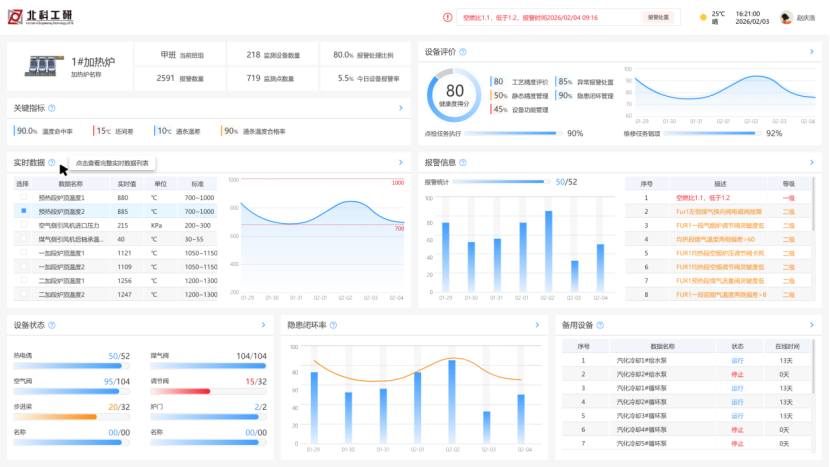
We have innovatively built a dual‑mainline AI agent service platform for "hidden dangers + faults":The hidden danger mainline uses AI agents to conduct real‑time modeling and analysis of multi‑dimensional operating data such as equipment vibration, temperature, and pressure, accurately capturing early degradation signs such as bearing wear, valve jamming, and abnormal temperature to realize early warning of hidden dangers.The fault mainline relies on mature AI rule engines, massive historical data, and knowledge bases to perform multi‑dimensional cross‑validation of equipment faults and quickly locate root causes.
Effect Comparison:Fault missing rate ≤ 5%, comprehensive fault monitoring accuracy > 90%. Early fault signs of mechanical, electrical, hydraulic, and other types of equipment can be accurately identified, driving the transformation of equipment O&M from traditional "post‑failure maintenance and empirical judgment" to "predictive maintenance and precise diagnosis".
(3)Multi‑Business Collaborative Optimization Based on Deep Learning — From Single O&M to Linked Efficiency Improvement
Traditional O&M decision‑making cannot support overall collaborative optimization of production. The service status of key equipment lacks scientific quantitative evaluation and cannot be correlated with line efficiency, production stability, and product defects.
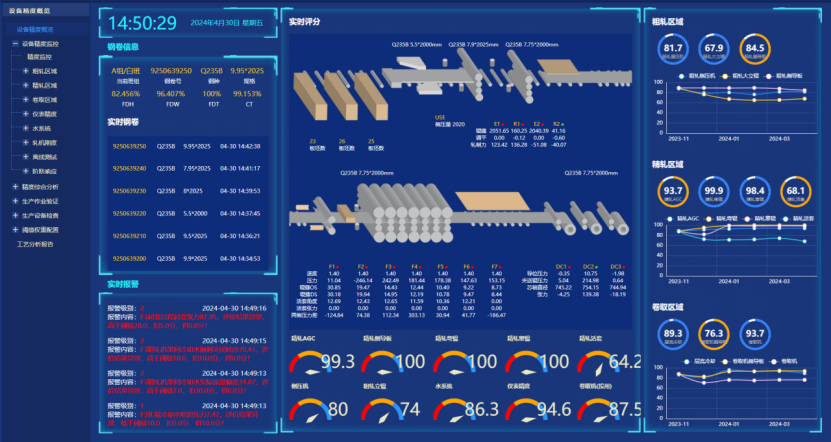
We have built a cross‑business linked AI optimization framework based on deep learning, which integrates core multi‑dimensional data including equipment operation, production scheduling, product quality inspection, and process parameters through deep learning algorithms. A quantitative correlation analysis model between equipment status, production efficiency, and product quality is established, and optimization suggestions for equipment operating parameters are provided.Based on model analysis results, we link the production department to adjust scheduling plans and the quality department to optimize inspection priorities, deeply integrating O&M decisions into the entire production process.
Effect Comparison:The impact coefficient of equipment operation status on line efficiency and product qualification rate is accurately quantified, achieving a 5% improvement in OEE. Equipment support, production efficiency, and product quality are simultaneously enhanced.
(4)AI O&M Assistant Based on Natural Language Models — From Manual Inspection to Intelligent Collaboration
Equipment inspection in iron and steel enterprises relies on manual on‑site recording and offline data query, resulting in heavy workload, non‑standard operations, low knowledge query efficiency, and slow knowledge transfer between new and experienced employees. When faults occur, equipment information, operating specifications, and solutions cannot be quickly retrieved, affecting fault handling efficiency.
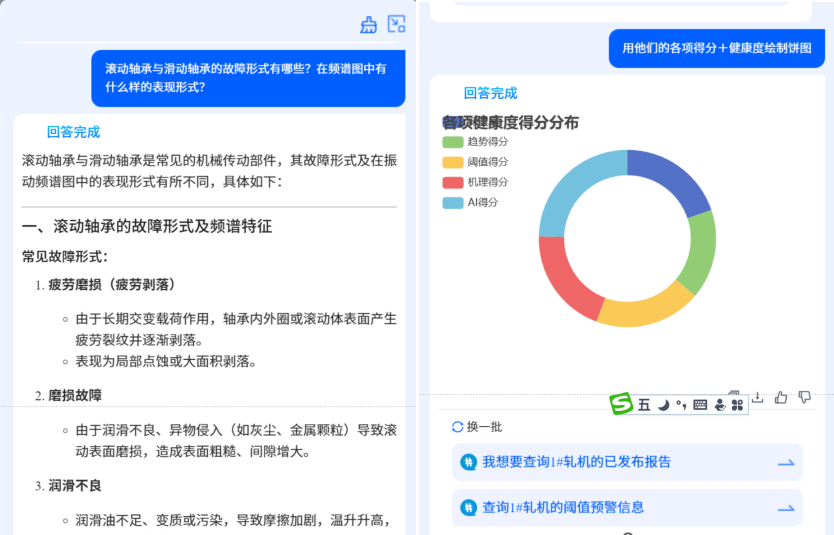
By deeply integrating multimodal knowledge bases, multi‑dimensional fault diagnosis models, and multi‑business collaborative analysis models, we have created a lightweight, scenario‑based intelligent O&M assistant. O&M personnel can quickly query PHM professional knowledge, equipment technical parameters, inspection standards, operating specifications, abnormal alarm handling procedures, and other core content via voice or text, realizing digital and intelligent management of inspection work.
Effect Comparison:Inspection workload reduced by more than 60%, fault handling efficiency improved by more than 40%, greatly reducing O&M errors caused by non‑standard operations and delayed knowledge queries. Natural language interaction enables rapid access and efficient inheritance of industry knowledge and on‑site experience, comprehensively improving the accuracy, operational standardization, and knowledge reuse efficiency of equipment O&M.
03 Promotion & Application of "AI + Equipment O&M"
With the implementation of the intelligent equipment O&M platform, related technologies and scenarios have been successfully applied in dozens of large‑scale domestic iron and steel enterprises and promoted overseas under the "Belt and Road" initiative, covering hot rolling, heavy plate, steelmaking, non‑ferrous metallurgical processing, and other production lines.Through in‑depth joint development with enterprises, massive full‑dimensional data on equipment operation, fault diagnosis, and process precision has been accumulated on localized platforms, integrating multiple intelligent O&M functional modules and systematic industry core knowledge.
The platform’s service capabilities cover mainstream production lines in the industry, realizing the deep integration of AI with the full process from equipment condition monitoring to O&M collaboration, significantly improving enterprises’ digital and intelligent O&M levels and production stability, and consolidating the equipment support foundation for industry digital transformation and high‑quality development.


官方公众号


