In 2026, the National Engineering Research Center for Advanced Rolling Technology (hereinafter referred to as "the Center") celebrates its 30th anniversary. Over the past three decades, the Center has traveled a hard yet brilliant path of domestic substitution for metal rolling technology—from automation to intelligence; from the domestic market to the "Belt and Road," its engineering practice has advanced from "applied in China" to "validated globally." At thirty, the Center is in its prime. These three decades of craftsmanship have unfolded a brand-new panorama for the metallurgical rolling field, forging not only a solid technological foundation and brand reputation for the Center, but also laying the confidence for continuous innovation. On the occasion of the Center's 30th anniversary, World Metals Bulletin launches this series of articles to present to readers the Center's three-decade journey of striving for excellence, its pioneering breakthroughs, its transformation nodes that keep pace with the times, and its rich achievements refined to the finest detail.
In 1996, China's iron and steel industry entered a crucial period of rapid output growth and accelerated modernization. Advanced equipment and process technologies kept emerging, yet in areas such as complete hot-rolling automation systems and their core mathematical models, comprehensive strip shape control technology, and online quality inspection equipment, domestic enterprises still relied on foreign suppliers for a long time, and some core technologies were subject to blockades. How to break through the constraints of key technologies and bring autonomous achievements onto the production line became an important issue facing China's metallurgical science and technology workers.
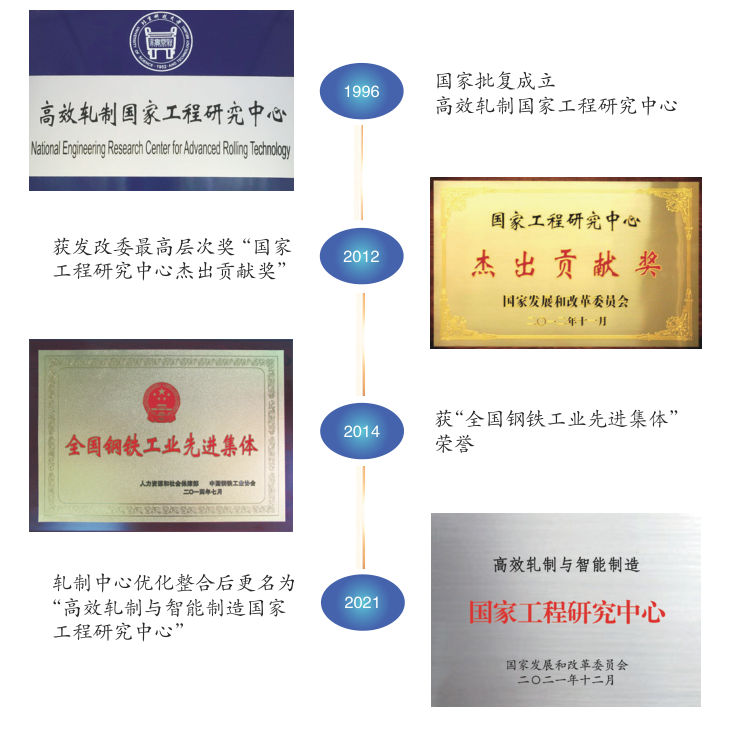
In 1996, relying on the University of Science and Technology Beijing (USTB), the Center was established; in 2021, to meet the new requirements of building a manufacturing and quality powerhouse, it completed optimization and integration and was officially renamed the National Engineering Research Center for Advanced Rolling Technology. Over the three decades, through institutional and mechanism innovation, a series of achievements have successively left the laboratory and entered the industrial site: multiple independently developed core metallurgical technologies have achieved comprehensive domestic substitution; strip hot-rolling automation systems are operating on more than 60 domestic hot-rolling production lines; full-process R&D capabilities for high-end steel and non-ferrous products serve more than 50 enterprises; strip shape control technology covers more than 100 production lines of different types; and more than 300 sets of 2D/3D metal surface inspection equipment have been cumulatively applied. Meanwhile, technologies such as full-process metallurgical quality control, digital R&D, intelligent equipment operation and maintenance, and digital twins have continued to achieve breakthroughs, and a number of autonomous technologies and complete solutions have entered overseas markets such as South Korea and Indonesia. From introducing advanced technologies and learning engineering experience, to independent R&D and industrial application, and then to exporting complete solutions, the Center's three-decade exploration mirrors the continuous enhancement of the technological capabilities of China's iron and steel and non-ferrous metals industries.
I. Breaking Barriers and Fostering Integration: Forging a New Path of Collaborative Innovation
A technological breakthrough in the laboratory is only the starting point toward industrial application. Steel production involves complex operating conditions and continuous processes; whether research results can withstand on-site testing and truly solve production problems was an issue the Center had to face from the very beginning of its establishment.
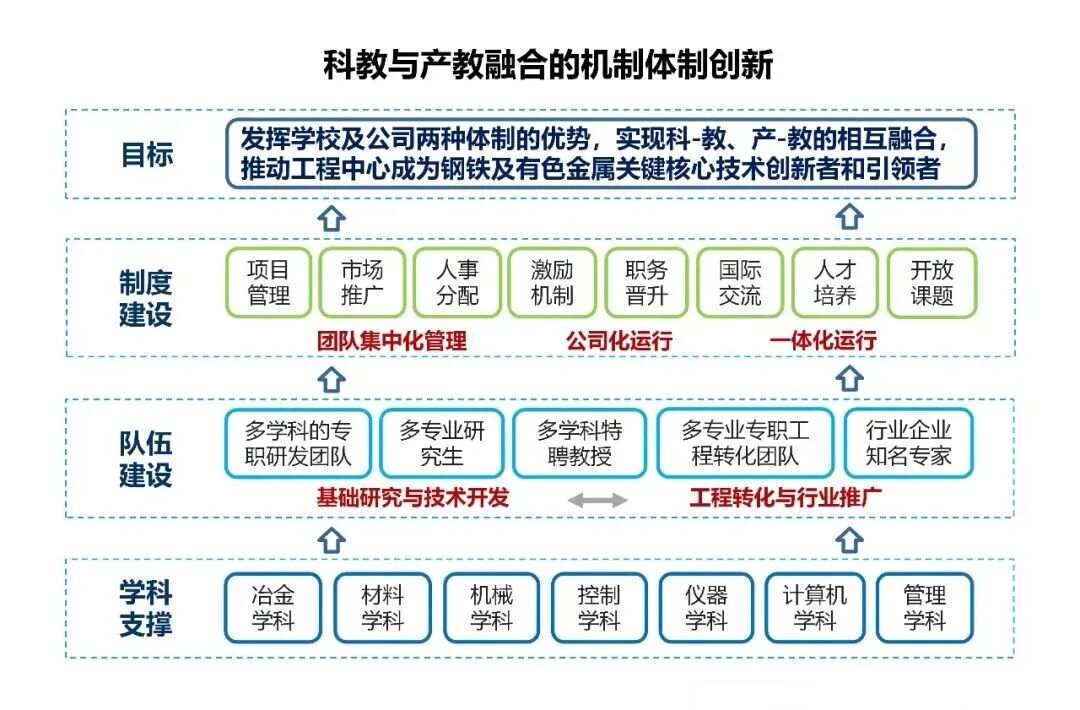
Relying on the disciplinary advantages accumulated by USTB in metallurgy, materials, machinery, automation, instrumentation, and other fields, the Center has gradually formed an industry–university–research–application collaborative innovation model driven by industrial demand, supported by multidisciplinary collaboration, and centered on industrial validation. At Shougang, the Center jointly established the "Joint R&D Center for Automotive Steel," promoting collaborative innovation across multiple regions, units, disciplines, and personnel, and helping Shougang's automotive sheet supply achieve a leap from zero to the top echelon in China within a short period. At Magang (Maanshan Iron & Steel), targeting the goal of "building a research base +," the Center overcame a number of key common industry technology challenges, including quality control in pipeline steel production, localization of the secondary model for the CSP production line, and construction of a smart hot-rolling plant.
A difficult problem in steel production often involves multiple fields such as materials, equipment, control, and information simultaneously. In the past, disciplinary boundaries and professional divisions tended to fragment complete industrial problems; relying on the Center's platform, however, different professional forces could conduct research around the same production goal and continuously improve their achievements within the "R&D–application–iteration" chain. Strip controlled rolling and controlled cooling technology is one example. Targeting cooling efficiency, temperature uniformity, temperature control precision, and the microstructure transformation laws of different steel grades, the team continuously carried out research on flow fields, equipment, models, and automatic control, forming a complete set of intensive and rapid strip cooling technology and equipment, which has been promoted and applied in enterprises such as Baowu, Ansteel, Shougang, HBIS, NISCO (Nanjing Iron & Steel Group), and Liuzhou Steel.
The connotation of collaborative innovation has also continued to expand with the digital transformation of the steel industry. Taking full-process metallurgical quality control technology as an example, the Center joined forces with enterprises to integrate multi-source heterogeneous data, metallurgical mechanisms, and quality analysis methods, using material identity as the main thread to connect data across different processes, and gradually established a full-process quality control system from raw materials to finished products. At present, the related technology has been applied to more than 80 digitalization projects in more than 40 enterprises such as Baowu, Ansteel, and CITIC Special Steel, covering products such as plates, coils, bars, wires, pipes, and wheels and axles, and extending to non-ferrous processing fields such as aluminum and copper.
University–enterprise cooperation thus no longer limits itself to solving a specific problem, but further aims at jointly building the capacity to solve problems continuously.
The production site is also an important classroom for talent growth. Batch after batch of young teachers, engineers, and graduate students have entered enterprises through the Center's platform: tracking production during the day and analyzing data at night; when model predictions were inaccurate, investigating changes in algorithms, data, and equipment status; when an anomaly occurred in a coil of steel, tracing the influencing factors item by item along the process flow. Many details that determine whether a technology can be implemented have no ready-made answers in textbooks and must be explored through repeated on-site practice. Over the past three decades, the Center has continuously supplied the steel industry with compound technical talents who understand both theory and the field, and who can both conduct research and implement engineering.
Advancing institutional and mechanism innovation for the integration of research and education, and of industry and education.
II. Independent Tackling: Building the Foundation of Core Technology
For research results to reach the production line, they must also form autonomous control capabilities in key links. Centering on basic theory, core models, and complete systems, the Center has focused its long-term tackling on the key technologies constraining rolling production. The strip hot-rolling automation control system was one of the directions the Center concentrated on early. After years of accumulation, the Center has gradually formed a strip hot-rolling automation control technology system covering L0–L3, realizing the system integration of basic automation, process control, and production management. The related technology has been applied to more than 60 domestic hot-rolling production lines in enterprises such as Ansteel, Handan Steel, and Shagang, covering different process types such as semi-continuous rolling, 3/4 continuous rolling, full continuous rolling, and Steckel mills, with products covering carbon steel, silicon steel, stainless steel, titanium plate, and aluminum alloy strip; it has also been extended to Taiwan, China, as well as overseas markets such as Indonesia. The related achievements have won one National Science and Technology Progress Award and three provincial and ministerial science and technology awards.
After the autonomous control of rolling line control was achieved, how to meet the more stringent strip shape requirements of high-end products became another problem that had to be overcome. As China's iron and steel industry shifts from scale expansion to high-quality development, the proportion of high-end products such as automotive sheet, electrical steel, high-strength steel, and stainless steel continues to rise. Focusing on roll-stack–rolled-piece deformation theory, variable-contact rolling technology, and full-process strip shape control, the Center has formed multi-scale integrated roll-stack–rolled-piece models, multi-function roll contours, and proprietary strip shape control technologies for high-end grades such as silicon steel and high-strength steel. The related achievements have been applied to more than 100 domestic hot-rolling production lines, covering various process types such as conventional hot continuous rolling, Steckel mills, CSP, ESP, and CASTRIP, including the 2,680 mm ultra-wide stainless steel hot-rolling production line, and have been exported to overseas markets such as South Korea and Indonesia.
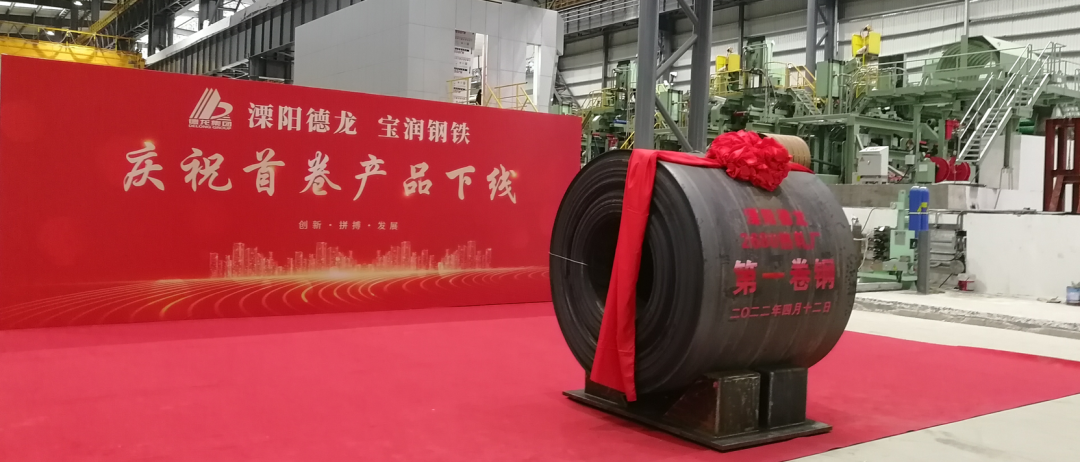
Overcoming the complete set of high-precision control systems for the world's widest 2,680 mm stainless steel strip hot continuous rolling.
As products continue to be thinned and rolling speeds keep increasing, higher requirements are placed on stable production. The Center combined online inspection, asymmetric rolling deformation theory, and data models to form a hot-rolling strip asymmetric measurement and control technology, realizing online perception of the intermediate slab's planar shape, warping, and strip deviation, and promoting the related control to gradually shift from manual intervention to automatic correction. The related technology has been applied at scale in more than 30 steel enterprises such as Baowu, Shougang, Ansteel, and HBIS.
Independent tackling did not stop at hot rolling. In the cold-rolling field, facing the characteristics of strong coupling and long time lag among processes such as pickling-rolling, continuous annealing, and hot-dip galvanizing, the Center integrated mechanism models with industrial big data to form a full-process digital-intelligent AI control system for cold rolling, and developed a series of models including dynamic control of plate thickness and strip shape, adaptive matching of furnace temperature, closed-loop control of zinc-coating thickness, deviation and slip warning, and yield optimization. The related technology has been applied to more than 40 pickling-rolling, continuous annealing, and galvanizing production lines in enterprises such as Baowu, Ansteel, Benxi Steel Plate Co., Ltd., and Jingye, covering high value-added products such as high-strength steel, electrical steel, and high-end automotive sheet.
Technology tackling also extends upstream to the refining process. Aiming at the problem that key states are difficult to directly observe and measure under high-temperature, multiphase, and multi-chemical-reaction environments, the Center integrated multi-physics-field rapid simulation, just-in-time learning, and deep reinforcement learning to develop an RH deep decarburization intelligent model, a dynamic digital twin model for external refining, and LF and RH agents, which have been implemented and applied in enterprises such as Xinyu Steel, ShougangQian'an Iron and Steel Co., Ltd., Pangang, and Yongfeng.
From hot-rolling automation to strip shape control, from cold-rolling process optimization to intelligent external refining, three decades of continuous tackling have enabled the Center to gradually form an autonomous technology system in which core models, control technologies, and system applications support one another.
III. Domestic Substitution: Reshaping the Industrial Competitive Landscape
Developing an autonomous system does not equate to completing domestic substitution. Over the past three decades, starting from demonstration projects, the Center has repeatedly tested and refined its technologies in long-term operation and cross-production-line promotion, pushing autonomous achievements from "being developable" to "being usable and promotable."
The promotion of hot continuous rolling automation is a microcosm of this process. From early single models and control functions to automation systems for entire production lines, autonomous technologies have withstood industrial on-site tests time and again. Mastering source code, process models, and system architecture not only gives enterprises stronger initiative in product development, production line renovation, and function expansion, but also shifts the competitive focus of domestic substitution from price to technological capability.
From control software to key measurement and control equipment, domestic substitution continues to extend to more links on the production front line, with metal surface quality inspection being a representative example. The Center has continuously conducted research on 2D/3D visual inspection and artificial intelligence recognition, independently developing a full series of metal surface inspection systems. The related equipment has achieved engineering application in enterprises such as Baowu, Xiangsteel, Lianyuan Iron & Steel (LY Steel), Ansteel, Shougang, Xingcheng Special Steel, and NISCO (Nanjing Iron & Steel Group), and has achieved import equipment substitution in some high-end hot-rolled plate production scenarios.
Changes are also taking place in the warehouse operation and industrial software fields. Through warehouse perception, machine vision positioning, production logistics optimization scheduling, and intelligent crane control, areas such as steel coil warehouses and slab warehouses that once required a large number of drivers and ground commanders have gradually achieved automation and unmanned operation; the related technology has been demonstrated and applied in more than 20 enterprises such as Xiangsteel, CITIC Special Steel, and Pangang. As digital transformation deepens, quality control, equipment operation and maintenance, digital R&D, and digital twins have become new application areas for domestic substitution. Intelligent equipment operation and maintenance technology covers core links such as steelmaking, hot rolling, cold rolling, and galvanizing; digital twin technology has been promoted in production lines of more than 20 enterprises.
The transformation and application of technological achievements also extends to the high-end materials field. Targeting the lightweight and safety performance needs of new-energy vehicles, the Center has developed advanced high-strength automotive steels covering strength grades of 1,500–2,200 MPa and product states such as hot rolling, pickling, annealing, and coating; the achievements have been applied in enterprises such as Shougang, Baowu, Ansteel, HBIS, and Shandong Steel, promoting the continuous improvement of the domestic advanced automotive steel product system. In the field of high-performance powder metallurgy titanium-based materials, the Center has established an autonomous technology system of "material design – powder preparation – near-net shaping – property control," developed semi-solid spheroidized titanium powder preparation technology and equipment, and established Beijing ZhongkeHongtai New Materials Technology Co., Ltd., promoting the achievements into application fields such as aerospace, biomedicine, and electronic communications.
From the demonstration operation of one system to the scaled application across different production lines; from automation software, inspection equipment, and industrial software to high-end materials, the continuous engineering practice has enabled the Center to gradually form a more complete autonomous technology supply capability.
IV. Expanding Along the Silk Road: Promoting the Going-Global of Chinese Solutions
Technologies that can stably operate on different domestic production lines must also withstand the test of overseas industrial sites. Differences in process conditions, equipment configurations, and production requirements place new demands on the adaptability and engineering implementation capabilities of autonomous technologies.
Strip hot-rolling automation and strip shape control were among the Center's earlier technologies to go overseas. After achieving scaled application domestically, the related achievements were gradually promoted to Taiwan, China, as well as markets such as South Korea, Indonesia, and the Middle East.
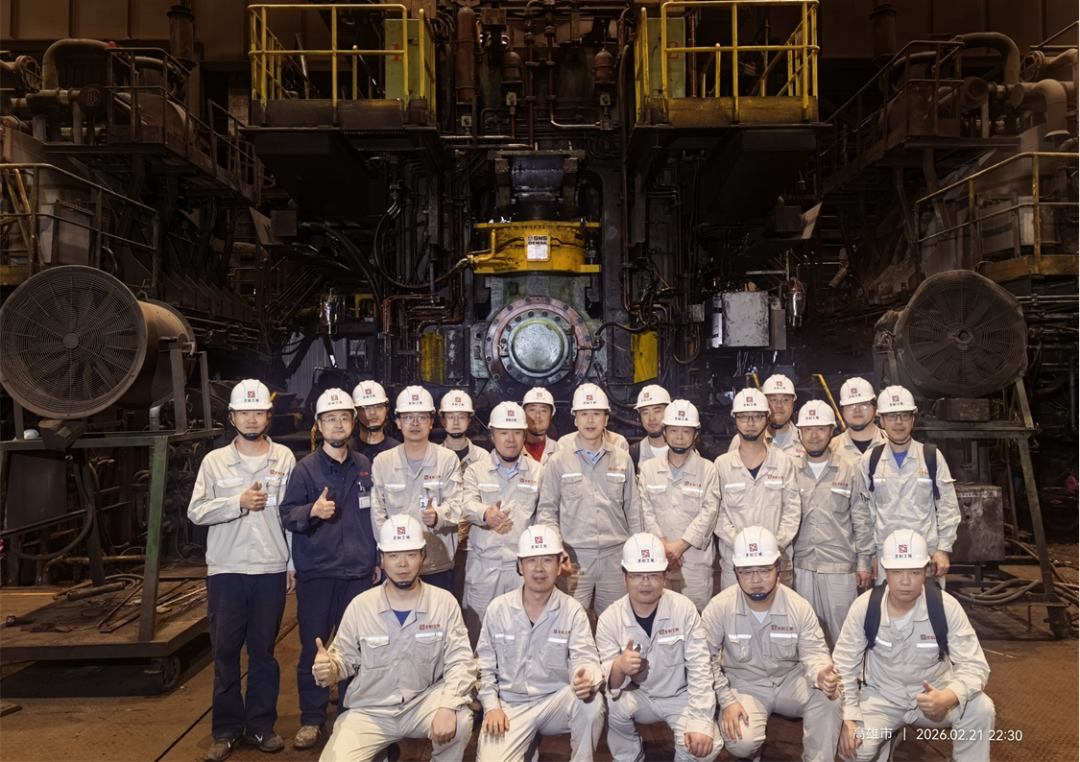
Technology exported for the revamping of the Steckel mill at Yieh United Steel Corporation (Taiwan, China).
With the in-depth advancement of the "Belt and Road" initiative, the content of the Center's overseas projects has also expanded: from early export of single technologies such as automation systems and strip shape control, to the combined application of various technologies such as intelligent centralized control, full-process quality control, equipment operation and maintenance, surface inspection, and digital twins. Indonesia is a representative market. In projects such as PT Indonesia Guang Ching Nickel and Stainless Steel Industry (GCNS) and Indonesia Tsingshan, the related technologies have extended from traditional rolling automation and strip shape control to intelligent centralized control, quality control, and digital twins; the delivered content has also gradually expanded from a set of software and a piece of equipment to comprehensive solutions serving an entire production line or even a whole plant.
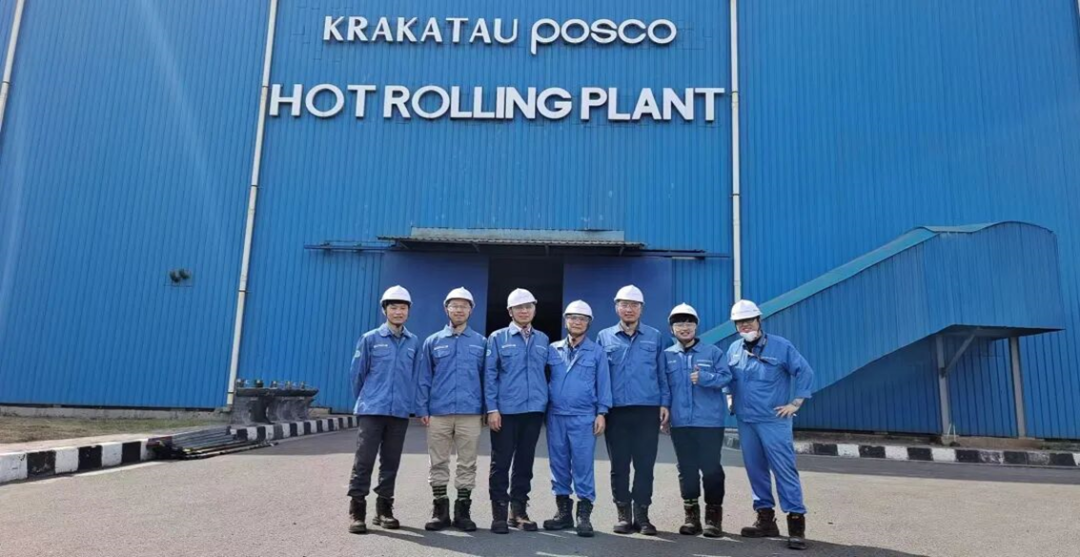
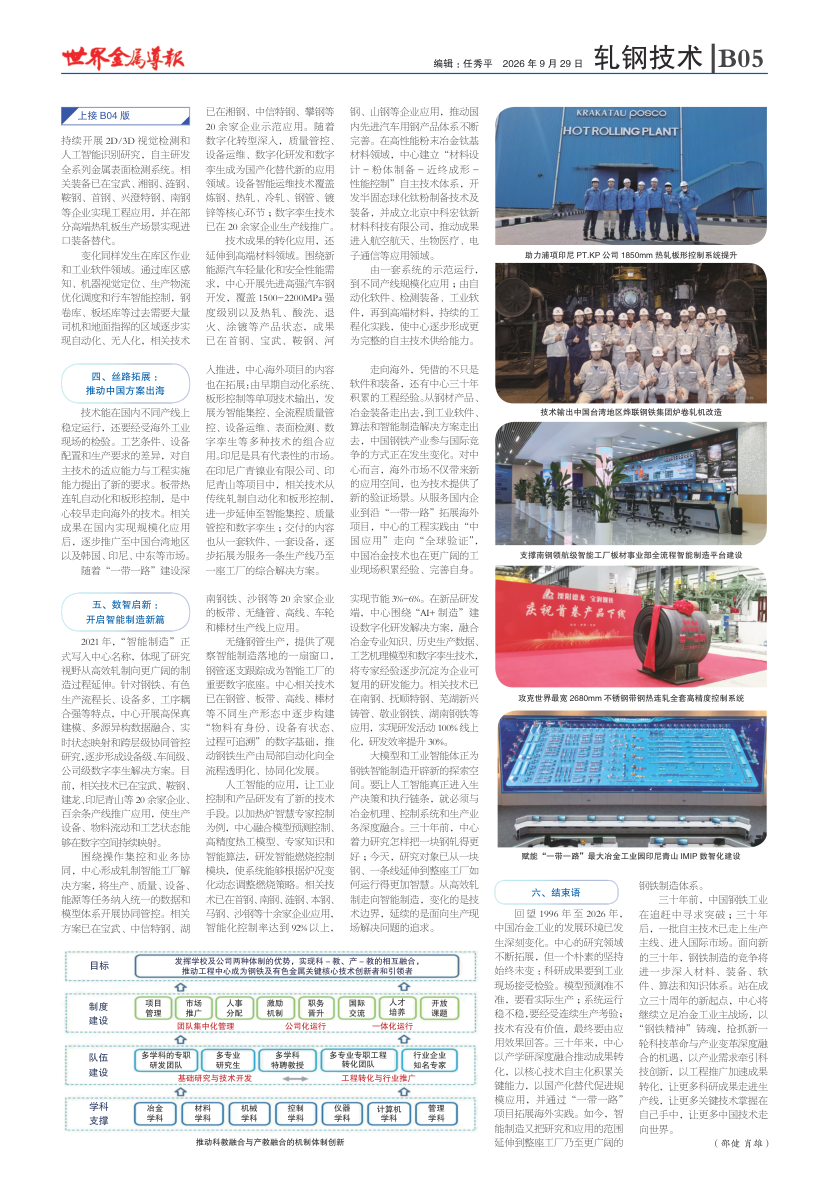
A complete set of digital-intelligent strip shape control technology applied to the 1,850 mm hot continuous rolling production line of POSCO's Indonesian joint venture PT. Krakatau Posco (PT.KP).
Going overseas relies not only on software and equipment, but also on the engineering experience the Center has accumulated over three decades. From steel products and metallurgical equipment going global, to industrial software, algorithms, and intelligent manufacturing solutions going global, the way China's steel industry participates in international competition is changing. For the Center, overseas markets not only bring new application space, but also provide new validation scenarios for technologies. From serving domestic enterprises to expanding overseas projects along the "Belt and Road," the Center's engineering practice has moved from "applied in China" to "validated globally," and Chinese metallurgical technology is also accumulating experience and improving itself in broader industrial sites.
V. Digital Intelligence Opens New Horizons: Ushering in a New Chapter of Intelligent Manufacturing
In 2021, "intelligent manufacturing" was officially written into the Center's name, reflecting the extension of its research vision from high-efficiency rolling to the broader manufacturing process. Targeting the characteristics of steel and non-ferrous production such as long processes, numerous equipment, and strong process coupling, the Center has conducted research on high-fidelity modeling, multi-source heterogeneous data fusion, real-time state mapping, and cross-level collaborative control, gradually forming equipment-level, workshop-level, and company-level digital twin solutions. At present, the related technology has been promoted and applied in more than 20 enterprises and over 100 production lines such as Baowu, Ansteel, Jianlong, and Indonesia Tsingshan, enabling production equipment, material flow, and process status to be continuously mapped in the digital space.
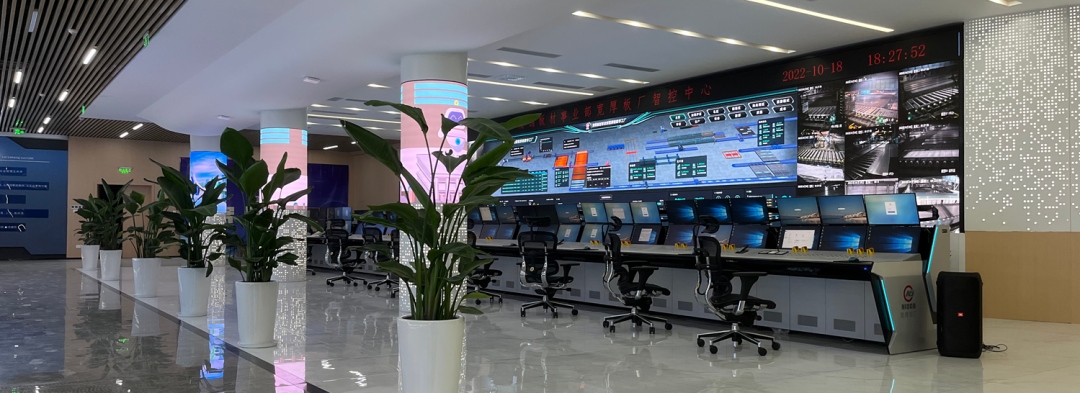
Supporting the construction of the full-process intelligent manufacturing platform for the plate business division of NISCO's pilot-level smart plant.
Centering on operational centralized control and business collaboration, the Center has formed a rolling intelligent plant solution that incorporates production, quality, equipment, energy, and other tasks into a unified data and model system for collaborative control. The related solution has been applied to the plate, seamless pipe, high-speed wire, wheel, and bar production lines of more than 20 enterprises such as Baowu, CITIC Special Steel, Hunan Steel Group, and Shagang.
Seamless steel pipe production provides a window to observe the implementation of intelligent manufacturing, and the individual tracking of each pipe has become an important digital foundation for the smart plant. The Center's related technology has gradually built a digital foundation of "materials with identity, equipment with status, and processes with traceability" in different production forms such as steel pipes, strips, high-speed wire, and bars, promoting the development of steel production from local automation to full-process transparency and collaboration.
The application of artificial intelligence has given industrial control and product R&D new technical means. Taking the intelligent expert control of reheating furnaces as an example, the Center integrated model predictive control, high-precision thermal models, expert knowledge, and intelligent algorithms to develop an intelligent combustion control module, enabling the system to dynamically adjust combustion strategies according to furnace condition changes. The related technology has been applied in more than ten enterprises such as Shougang, NISCO (Nanjing Iron & Steel Group), Lianyuan Iron & Steel (LY Steel), Benxi Steel Plate Co., Ltd., Magang (Maanshan Iron & Steel), and Shagang, with an intelligent control rate of over 92% and energy savings of 3%–6%. On the new-product R&D side, centering on "AI + manufacturing," the Center has built a digital R&D solution that integrates metallurgical expertise, historical production data, process mechanism models, and digital twin technology, gradually precipitating expert experience into reusable R&D capabilities for enterprises. The related technology has been applied in NISCO (Nanjing Iron & Steel Group), Fushun Special Steel, Wuhu Xinxing Ductile Iron Pipes, Jingye Steel, and Hunan Steel Group, achieving 100% online R&D activities and a 30% improvement in R&D efficiency.
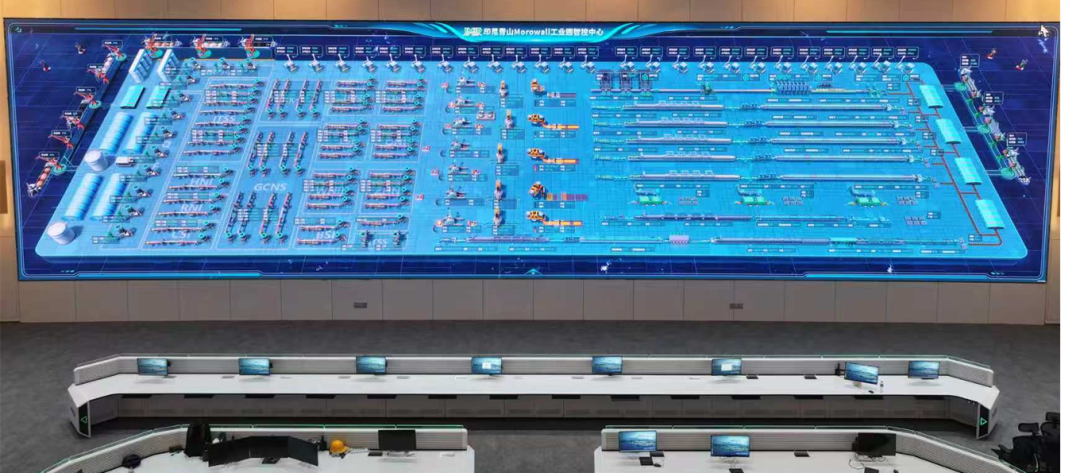
Empowering the digital-intelligent construction of IMIP, Indonesia Tsingshan — the largest metallurgical industrial park under the "Belt and Road" initiative.
Large models and industrial agents are opening up new exploration space for steel intelligent manufacturing. To truly bring artificial intelligence into the production decision-making and execution chain, it must be deeply integrated with metallurgical mechanisms, control systems, and production operations. Three decades ago, the Center focused on how to roll a piece of steel better; today, the research object has extended from a piece of steel and a single line to how an entire plant operates more intelligently and efficiently. From high-efficiency rolling to intelligent manufacturing, what has changed is the boundary of technology, while what continues is the pursuit of solving problems at the production site.
VI. Concluding Remarks
Looking back from 1996 to 2026, the development environment of China's metallurgical industry has undergone profound changes. The Center's research fields have continuously expanded, but one simple persistence has never changed: research results must be tested at the industrial site. Whether a model's prediction is accurate must be seen in actual production; whether a system runs stably must withstand the test of continuous production; whether a technology has value must ultimately be answered by the application effect. Over the past three decades, the Center has promoted achievement transformation through deep industry–university–research integration, accumulated key capabilities through autonomous core technology, promoted scaled application through domestic substitution, and expanded overseas practice through "Belt and Road" projects. Today, intelligent manufacturing has extended the scope of research and application to entire plants and even the broader steel manufacturing system.
Three decades ago, China's iron and steel industry sought breakthroughs in catch-up; three decades later, a batch of autonomous technologies have stepped onto the main production line and entered the international market. Facing the new three decades, competition in steel manufacturing will further penetrate into materials, equipment, software, algorithms, and knowledge systems. Standing at the new starting point of its 30th anniversary, the Center will continue to base itself on the main battlefield of the metallurgical industry, forge its soul with the "steel spirit," seize the opportunities brought by the deep integration of a new round of scientific and technological revolution and industrial transformation, drive scientific and technological innovation with industrial demand, accelerate achievement transformation with engineering promotion, bring more research results into production lines, master more key technologies in its own hands, and let more Chinese technologies go global.
(Shao Jian, Xiao Xiong)
World Metals Bulletin
Issue 37, 2026, pp. B04–B05


官方公众号


