Introduction
In August 2025, the State Council issued the Opinions on Further Implementing the "AI+" Initiative, clearly requiring the promotion of intelligent linkage of all industrial factors and accelerating the application of artificial intelligence in the whole process of design, pilot test, production, service and operation. In December 2025, eight ministries and commissions including the Ministry of Industry and Information Technology and the National Development and Reform Commission jointly issued the Implementation Opinions on the Special Action of "AI+Manufacturing", further urging the accelerated integration and application of AI technologies in the manufacturing sector to foster new quality productive forces.
In recent years, the Institute of Engineering Technology,University of Science and Technology Beijing (hereinafter referred to as "IET") has leveraged its talent and technological strengths to continuously deepen the integration of artificial intelligence with core businesses, tackle industry pain points, and build core competitiveness. A series of special reports on IET,USTB’s "AI+Business Domains" practices will be released in the near future.
AI+Digital R&D: Pressing the "Accelerator" for High-End Product Development in Iron & Steel Enterprises
Based the dual background of surging demand for high-end manufacturing and intensifying industry competition, bottlenecks such as low efficiency and high costs under the traditional R&D model have become major obstacles to the high-quality development of enterprises. For the digital and intelligent transformation of iron and steel enterprises, the intellectualization of the R&D sector is a critical starting point.
Using digital tools to summarize experience with data, optimize design with AI, and reduce trial and error through simulation has become a core pathway for iron and steel enterprises to achieve intelligent, precise and efficient R&D across the whole process. This helps enterprises shift from "passive response" to "active innovation", break through product homogenization, and seize the high-end market.
01 Overall Concept of "AI+Digital R&D"
Targeting common pain points in steel product R&D — including difficulties in knowledge reuse, high trial-and-error costs, and underutilized data value — "AI+ Digital R&D" is based on the integration of processes, data and knowledge across R&D, production and sales.It centers on building a complete R&D chain and toolset covering product design → process planning → quality prediction → simulation verification, to comprehensively accelerate and improve R&D efficiency for steel enterprises:
•Leverage AI virtual simulation and prediction to drastically reduce physical trial-and-error and shorten R&D cycles;
•Realize precise parameter optimization and quality pre-judgment to improve R&D success rate and product stability;
•Transform fragmented knowledge and experience into computable, reusable digital models, enabling the accumulation and inheritance of enterprise technological capabilities, making R&D innovation more efficient, precise and economical.
02 Typical AI Application Scenarios for Digital R&D
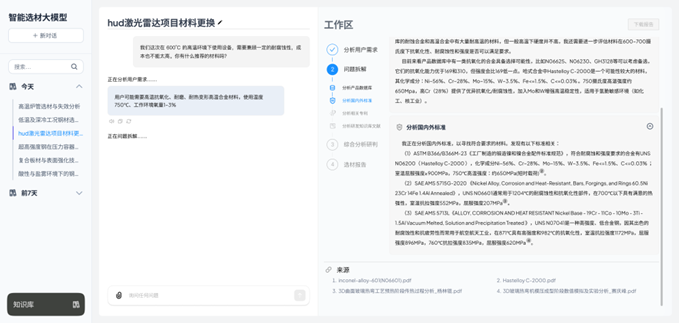
AI Agent-Based Material Selection Tool — From Reliance on Experience to Precise Matching
To meet customized customer demands, product engineers traditionally had to consult extensive manuals and historical experience for material selection based on performance, cost and application scenarios, taking 1–2 days with low accuracy and often missing optimal solutions due to experience limitations.
By building a database covering massive steel grades and application scenarios and establishing an intelligent mapping model, the AI agent can complete scenario understanding, big-data retrieval and matching within 10 seconds, recommend 3–5 optimal steel grade solutions, and provide in-depth multi-dimensional analysis and suggestions.
Effect Comparison: Material selection efficiency increased by over 90%, recommendation accuracy reached above 80%, enabling rapid response to customized demands and greatly reducing communication and screening costs in product R&D.
Knowledge Model-Based Process Plan Recommendation — From Fragmented Exploration to Systematic Reuse
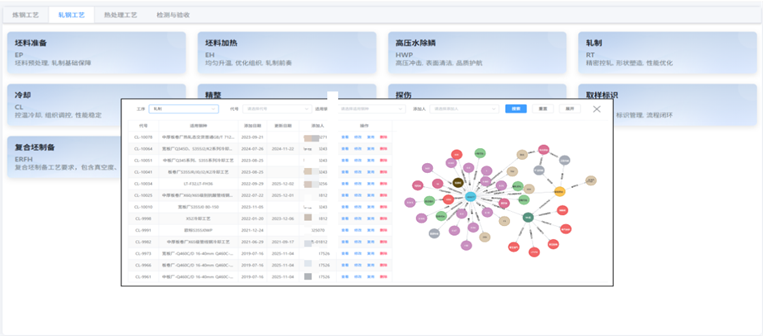
Traditional process design heavily relies on personal experience and intuition, often involving repeated trial and error, leading to uncontrollable R&D cycles and costs.
By constructing a dedicated process knowledge graph and high-quality dataset for digital R&D, scattered process design experience is transformed into computable and inferable knowledge models. The system can not only automatically recommend optimal process parameters but also link with the QMS system to generate control plans, ensuring predictability and implementability in actual production.
Effect Comparison: Full-process design time for new products reduced from weeks to hours; adoption rate of intelligently recommended process plans exceeds 70%, realizing rapid reuse of production process knowledge.
Deep Learning-Based Performance Prediction Model — From Experimental Inference to Model Pre-Judgment
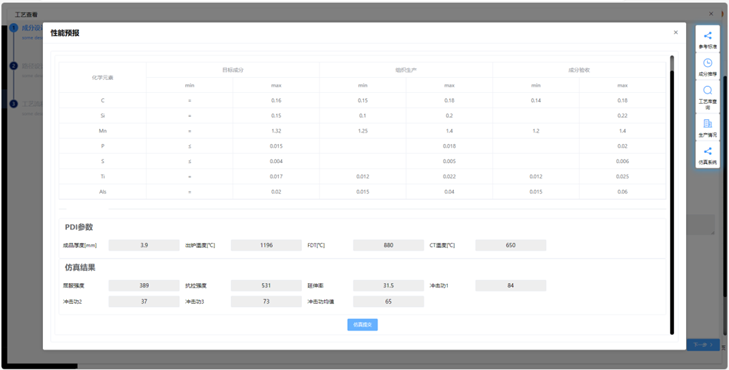
Performance evaluation in traditional new product development depends on numerous physical tests, which are time-consuming, costly, and difficult for impact analysis and multi-objective optimization.Based on metallurgical mechanisms, a basic model framework covering various steel series is built. Using deep learning algorithms, it integrates more than 200 core parameters from the entire steelmaking and rolling process. After training with massive production data and fine-tuning with high-quality experimental data, the model realizes prediction, design and optimization of key material properties.
Effect Comparison: Performance pre-judgment shortened from experimental-level time to second-level response; physical experiments reduced by 60%, greatly cutting R&D trial-and-error costs.
Digital Simulation-Based Process Simulation Platform — From Physical Trial and Error to Virtual Verification
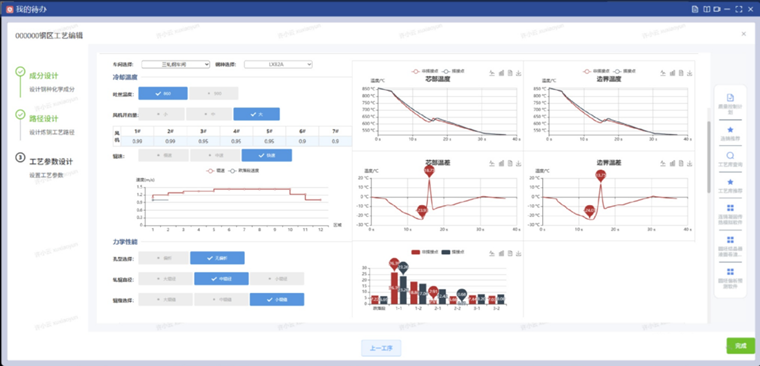
New products and processes usually require multiple rounds of trial production, which is time-consuming, costly and occupies valuable production time, harming line efficiency.A digital process simulation platform integrates AI and mechanism simulation to realistically reproduce the full process — including steelmaking, continuous casting, rolling and heat treatment — in a virtual environment, identifying defects and risks in process design in advance for optimization.
Effect Comparison: Trial production times for new products and processes reduced by more than 1/3 on average; R&D cycle greatly shortened, with significantly less disruption to normal production.
03 Promotion and Application of "AI+ Digital R&D"
Supported by the digital R&D platform construction, technologies and scenarios of "AI+ Digital R&D" have been implemented in enterprises including Ningbo Iron & Steel, Fushun Special Steel, Nanjing Iron & Steel, Wuhu Xinxing Ductile Iron Pipes, and Yongfeng Iron & Steel.Through joint development with enterprises, the locally deployed platforms have accumulated tens of thousands of process specifications and quality defect data, integrated dozens of material calculation tools and process simulation APPs, and stored massive core knowledge in product design, process development and quality improvement.The platform’s R&D capabilities cover major products such as strips, plates, bars, wires and forgings. It has basically achieved deep integration of AI across the whole process from product design and process development to quality improvement, significantly enhancing enterprises’ R&D efficiency.


官方公众号


