Against the backdrop of prevalent high-end and customized production, the traditional segmented quality management model can no longer fundamentally enhance the quality competitiveness of steel enterprises. Amid the digital and intelligent transformation, it is urgent to upgrade quality management from partial control to company-wide governance. Supported by the full-process Quality Management System (QMS) and deeply integrated with AI technologies, IET,USTB breaks down business barriers, realizing unified formulation of quality objectives, unified risk assessment and unified collaborative quality improvement. Quality is turned into a core competitiveness that can be designed, predicted and iterated.
01 Overall Approach to AI + Smart Quality Management
To address deep-seated challenges including inconsistent quality objectives, delayed risk response and insufficient collaboration in steel enterprises, our AI-powered smart quality solution is built on three major pillars and supported by organizational empowerment to reshape collaboration modes:
•Data pillar: Connect all production processes to build a quality "digital gene chain" for full-domain data connectivity.
•Decision pillar: Realize cross-process AI collaborative optimization, shifting production decision-making from experience-driven to intelligence-driven.
•Knowledge pillar: Establish an iterable quality knowledge system to inherit and evolve valuable operational experience.
•Organizational empowerment: Redefine the collaboration between quality inspectors, technicians and operators. Staff are freed from repetitive work to focus on abnormal issue handling, rule optimization and strategic decision-making.
These four components upgrade quality management from passive "remedial action after problems occur" to active "prediction and risk prevention", and ultimately form a collaborative operation system featuring intelligent early warning, targeted manual intervention and continuous knowledge accumulation.
02 Typical Application Scenarios of AI + Smart Quality Management
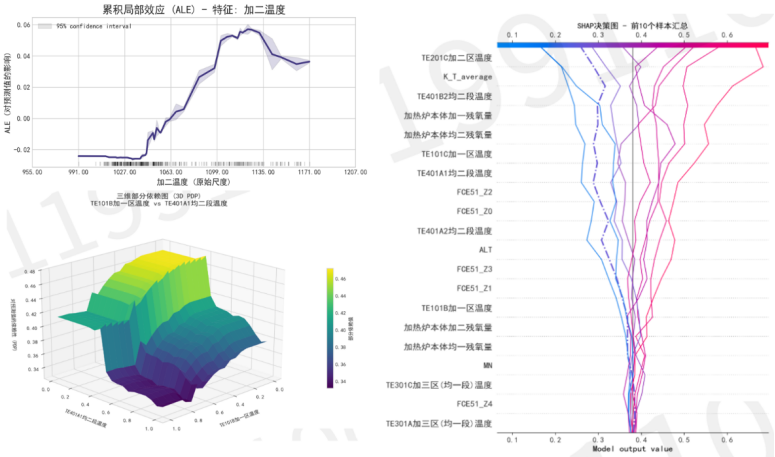
Intelligent System: Build a Predictive Immunity Network for Quality Disturbances
Pain points: Fluctuations in raw material composition, equipment performance degradation and changing working conditions repeatedly trigger quality problems. Adjustments limited to single processes can only address superficial issues. Hidden risks are amplified along the long production chain, leading to performance disqualification, cracks, poor strip profile, dimensional deviation and other defects.
Solutions: Develop a cross-process quality prediction and collaborative compensation model based on AI algorithms. Instead of focusing on individual parameters, the model analyzes full-domain data transmitted across time and working procedures. For example, if the model detects a 0.01% rise in phosphorus content in raw materials, it will predict its cumulative impacts on steelmaking, refining, continuous casting and hot rolling in advance, generate cross-process compensation schemes at the steelmaking stage, and automatically fine-tune process parameters of subsequent procedures to ensure full-process quality control.
Results: Quality risk control is moved from post-inspection to pre-prediction and in-process collaborative prevention. The one-pass quality rate of the whole process increases steadily by 3%–5%. The steady-state control capability of key process parameters is significantly enhanced. Unplanned downtime and product downgrading caused by quality disturbances drop by over 10%, enabling stable full-process production.
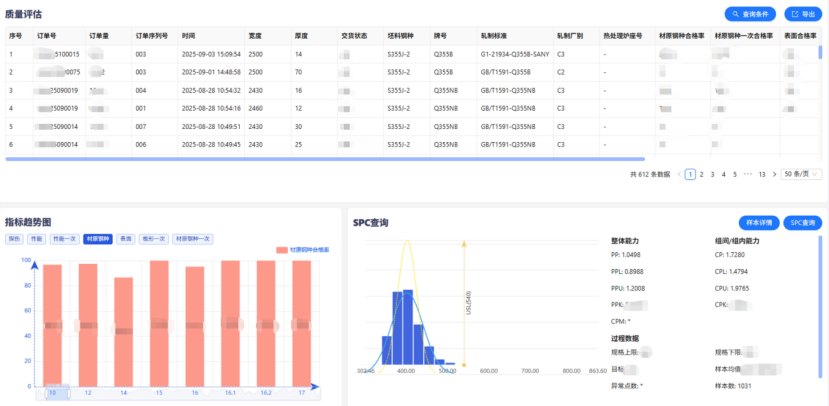
Collaborative Decision-making: Find the Global Optimum for Quality, Cost and Efficiency
Pain points: Quality, cost, delivery schedule and energy consumption often conflict with each other, resulting in trade-offs in production decisions. Over-design such as excessive alloy addition or overly strict process requirements may be adopted to guarantee quality; alternatively, quality stability may be compromised to boost output. Departments constantly balance multiple conflicting objectives.
Solutions: Treat the entire production process as a real-time dynamic optimization problem. The AI engine simulates full-process production paths, rapidly evaluates combinations of key parameters including alloy dosage, temperature curves and rolling schedules, and calculates their comprehensive impacts on production cost, efficiency and quality compliance rate. Real-time global optimal collaborative production strategies are delivered.
Results: Production decisions are upgraded from feasible options for single indicators to optimal solutions balancing multiple objectives. With quality standards fully maintained, quality-related costs are cut by around 3%, and the on-time quality delivery rate rises by about 3%. Enterprises achieve the transformation from qualified manufacturing to economical intelligent manufacturing.
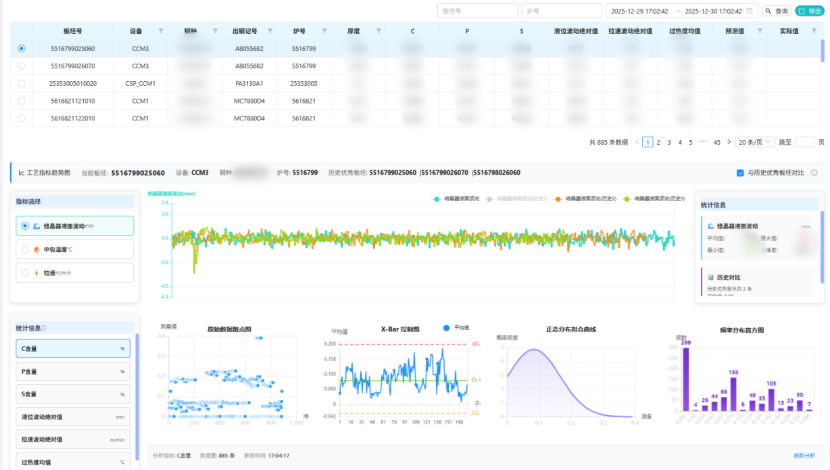
Knowledge Accumulation: Inherit Best Practices and Lessons Learned
Pain points: Core operational logic behind high-quality production batches achieved by skilled operators is hard to standardize and replicate. Conclusions from major quality incidents may be repeated due to staff turnover. Core process knowledge is scattered in personal experience and fragmented reports, failing to form systematic and evolvable collective wisdom.
Solutions: Adopt a dual-drive model consisting of a production case library and a decision support engine to systematize process knowledge. Full-process data, operation records and quality results of each heat, each slab and each steel coil are structured into standard production cases. The system automatically recommends optimal operations when current working conditions match historical high-quality cases, and issues early warnings when parameters show early signs of potential failures.
Results: Individual experience and historical lessons are transformed into enterprise-level organizational knowledge. For engineers handling quality disputes and process optimization, root cause analysis that traditionally takes one week can be completed within minutes, lifting analysis efficiency by over 30%. Core process knowledge becomes permanent digital assets, laying a foundation for continuous technological innovation.
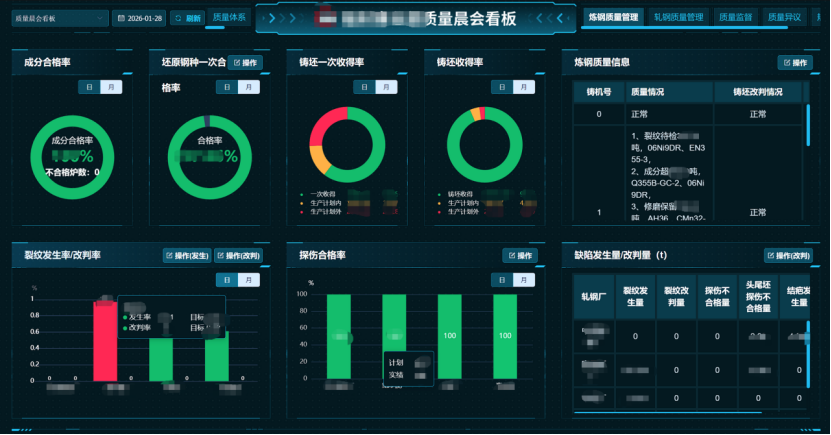
Organizational Empowerment: Reshape the New Man-Machine Collaboration Mode for Quality Governance
Pain points: The traditional relationship between personnel and systems is limited to simple monitoring. Frontline staffs are overwhelmed by parameter alarms and quality emergencies, while senior engineers are trapped in repetitive data analysis. Neither group can focus on core process optimization and forward-looking innovation.
Solutions: Establish a new man-machine collaboration mode of AI cockpit + expert think tank to redefine the division of labor between humans and systems. For frontline operators, the system provides operational guidance, offers multiple economical solutions and risk reminders for key decisions such as alloy adjustment and rolling mill setting, turning operators from passive performers into active decision-makers. For engineers, the AI system acts as a powerful analytical assistant, automatically correlating abnormal data, pushing similar cases and proposing root cause assumptions, transforming engineers from data collectors to problem solvers. For managers, a panoramic quality dashboard displays real-time quality risk maps and performance indicators to support efficient strategic decision-making.
Results: A scientific man-machine division of labor is realized. AI systems handle massive data processing, complex computation, trend prediction and scheme recommendation, while humans focus on value judgment, risk control, strategic decision-making and creative work. The work mode of engineers evolves from 80% passive response and 20% active prevention to 20% passive response and 80% active prevention. All staffs are freed from repetitive quality control work and able to focus on quality improvement and continuous innovation.
03 Promotion and Application of AI + Smart Quality Management
The concepts and technologies of AI-powered smart quality management have been implemented and explored in multiple steel enterprises including Nanjing Iron & Steel, Lianyuan Iron & Steel, Xiangtan Iron & Steel and Wuhu Xinxing Ductile Iron Pipes. In cooperation with enterprises, we build company-wide quality management systems and continuously update quality rules, risk models and collaboration mechanisms on localized QMS platforms, covering multiple product types and core working procedures. Going forward, IET,USTB will further deepen the integration of AI and steel quality management systems, helping enterprises build a large-scale corporate quality system with controllable risks, efficient collaboration and sustainable evolution, and supporting the high-quality development of the steel industry.


官方公众号


